


Most businesses only think about security after a break-in, which can cost $8,000 to $30,000 per incident. But a locksmith’s security assessment can help you avoid these costs by identifying weaknesses before they’re exploited. Here’s what locksmiths evaluate:
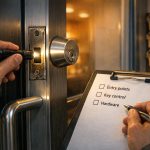
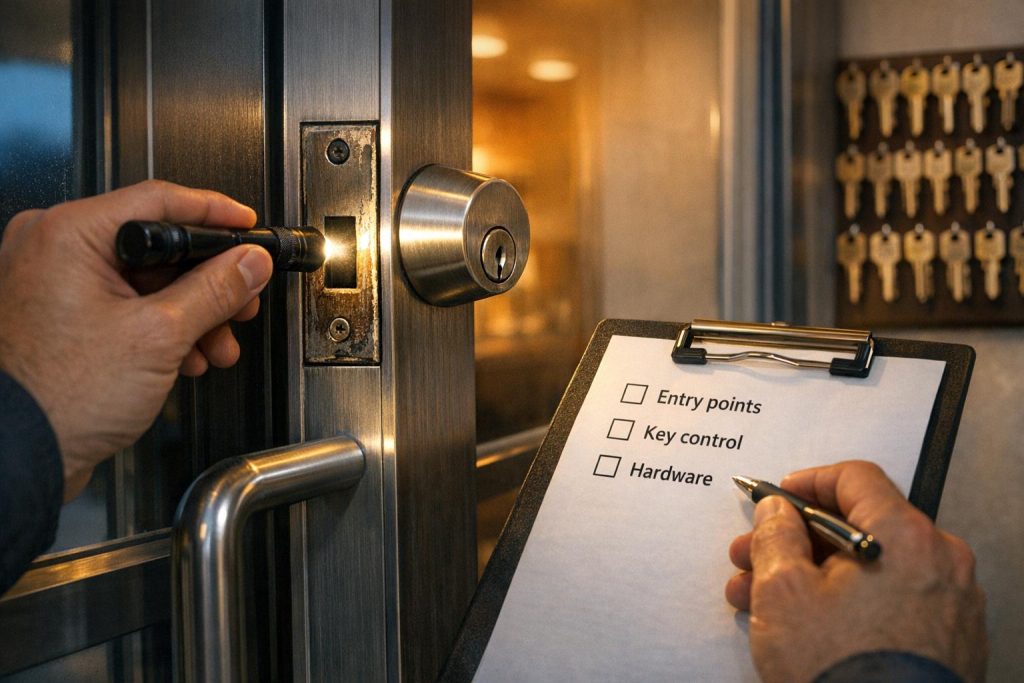
- Entry Points: Doors, windows, and emergency exits are inspected for weak locks, worn frames, or improper installation.
- Perimeter Security: Fences, gates, lighting, and landscaping are checked for vulnerabilities.
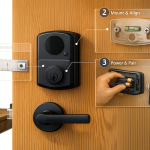
- Door Hardware: Locksmiths test locks, hinges, and door materials to ensure they can withstand forced entry.
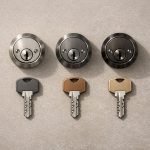
- Key Management: Policies for key control and access systems are reviewed to prevent misuse.
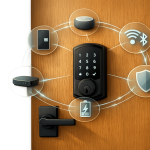
- Security Upgrades: Recommendations include electronic lock technology, reinforced frames, and electronic access controls.
A professional assessment not only protects your property but can also reduce insurance premiums by 5% to 20%. Locksmiths provide a prioritized plan to address immediate risks and long-term improvements, helping businesses stay secure and compliant.
How Commercial Locksmiths Help Prevent Internal Theft
sbb-itb-643e28e
Site Walkthrough and Perimeter Inspection
The first step in a commercial security assessment is conducting a detailed walkthrough of the property’s exterior. Locksmiths typically start with official floor plans or evacuation maps found near stairwells to pinpoint every access point. This initial step creates a foundation for later evaluations of locks, hardware, and other security measures.
"The walk through requires an investment of your time… Generally, an in-person presentation is far more effective than a telephone call, email or letter." – Tim O’Leary, Security Consultant
Walkthroughs are conducted during both daylight and nighttime hours to uncover vulnerabilities that may shift with lighting conditions. For instance, a door that seems secure in broad daylight might be hidden in shadows at night, creating opportunities for intruders. This dual-timing approach also highlights other factors, like overgrown landscaping or poorly lit secondary entrances, that could weaken security.
Finding All Entry Points
During inspections, locksmiths document every type of access point, including staff and visitor entrances, emergency exits, loading docks, windows, and skylights. They carefully examine door frames and hinges for signs of wear or improper installation that could make forced entry easier. Windows and skylights often present unique challenges, as they are easily overlooked yet highly vulnerable to break-ins through broken glass or weak locks.
The assessment doesn’t stop at exterior points. Internal sensitive areas, like server rooms, cash handling zones, and inventory storage areas, are also scrutinized. During peak business hours, locksmiths observe practices such as propping doors open or instances of "tailgating", where unauthorized individuals follow employees into secure areas. Emergency exits are checked to ensure they are equipped with code-compliant panic bars, which allow for quick exits while keeping the building secure from the outside.
Once all access points are mapped, locksmiths shift their focus to strengthening the property’s external defenses.
Checking Perimeter Security
After identifying internal vulnerabilities, attention turns to the property’s outer defenses.
"Your perimeter is your first line of defense. The same way a homeowner won’t leave their front door vulnerable, commercial property owners and business owners should not leave their building security to chance." – Hugo Reed, United Locksmith
Perimeter inspections include checking fences and walls for structural integrity. Locksmiths look for holes, weak spots, or inadequate height that could compromise security. Gates are tested for locking mechanisms, motor strength, and the effectiveness of secondary measures like padlocks or chains on pedestrian access points.
Lighting is another critical factor. Professionals assess lighting coverage around entrances, parking lots, and pathways, ensuring that motion-activated lights don’t create glare that could interfere with security cameras. Landscaping also plays a role; overgrown trees and shrubs can provide hiding spots or even act as natural "ladders" for intruders to access upper floors or climb over fences. Clear signage, such as "No Trespassing" or "Authorized Personnel Only", is verified at all access points to serve as both a legal warning and a psychological deterrent.
These thorough evaluation methods, used by professionals like those at Sherlock’s Locksmith, help ensure that a property’s exterior defenses are robust and its vulnerabilities addressed, forming a strong foundation for a secure commercial space.
Door and Frame Hardware Inspection
Once the perimeter is secured, locksmiths shift their focus to doors, which account for 58% of forced entry attempts. This in-depth hardware inspection builds on the initial perimeter check, targeting any weak points that could be exploited. Interestingly, in about 65% of forced entry cases, door frames fail before the locks themselves. This underscores the importance of ensuring the structural strength of both the door and its frame, alongside the quality of the lock.
"A door is only as secure as its weakest component – and for many homes, that component is the frame surrounding it." – Driscoll’s Lock & Key
During inspections, locksmiths look for damage, misalignment, or weak mounting in both doors and frames. They check that gaps between the door and frame don’t exceed 1/8 inch, as larger gaps make forced entry easier. Signs of tampering, like cracks or splintering around the lock area, are also red flags that the door may have been compromised.
Checking Door Materials and Construction
The material a door is made from plays a big role in its ability to resist force. Locksmiths evaluate whether doors are constructed from hollow metal, solid wood, or aluminum storefront materials. Hollow metal doors are inspected for issues like warped metal or frame separation, while solid wood doors are checked for rot or moisture damage that can weaken their structure.
Fiber-reinforced plastic (FRP) doors are becoming a popular choice for their durability against both weather and physical attacks. These doors typically last around 20 years and can save money over time due to lower maintenance and repainting costs, as highlighted by Andrew Paschall of Special-Lite.
Locksmiths also ensure that door hardware meets industry standards. For high-traffic entrances, Grade 1 hardware is recommended. In medium-duty interior spaces, Grade 2 hardware is acceptable, but Grade 3 hardware is generally not sufficient for security needs.
Once the door’s construction is evaluated, locksmiths focus on reinforcing its components to better resist forced entry.
Examining Door Frames and Reinforcements
After assessing the door, locksmiths turn their attention to the frame, which often presents vulnerabilities. A common issue is the use of short screws – typically 1/2-inch – that only secure strike plates and hinges to thin trim, rather than the structural wall studs. Replacing these with 3-inch screws ensures a stronger connection to the framing, significantly improving resistance to forced entry.
For out-swinging doors, locksmiths check that hinges are recessed, as exposed hinge pins can be removed using power tools. Adding hinge security pins (jam pins) helps keep the door in place even if the hinges are tampered with.
Alignment problems are another concern. Locksmiths look for doors that scrape the floor, make grinding noises, or have visible gaps that let in daylight. Misalignment can prevent the latch from engaging properly with the strike plate. Bob Karrer of dormakaba Americas points out that businesses often try to solve this by filing down strike plates, but the correct approach is to realign the door, frame, or hinges.
Additional reinforcements like latch guards can cover gaps and prevent prying attacks. Torque collars on mortise cylinders also help resist twisting attacks. When combined with proper installation techniques, these adjustments turn vulnerable doors into strong barriers that deter forced entry.
Lock Inspection and Security Rating Check
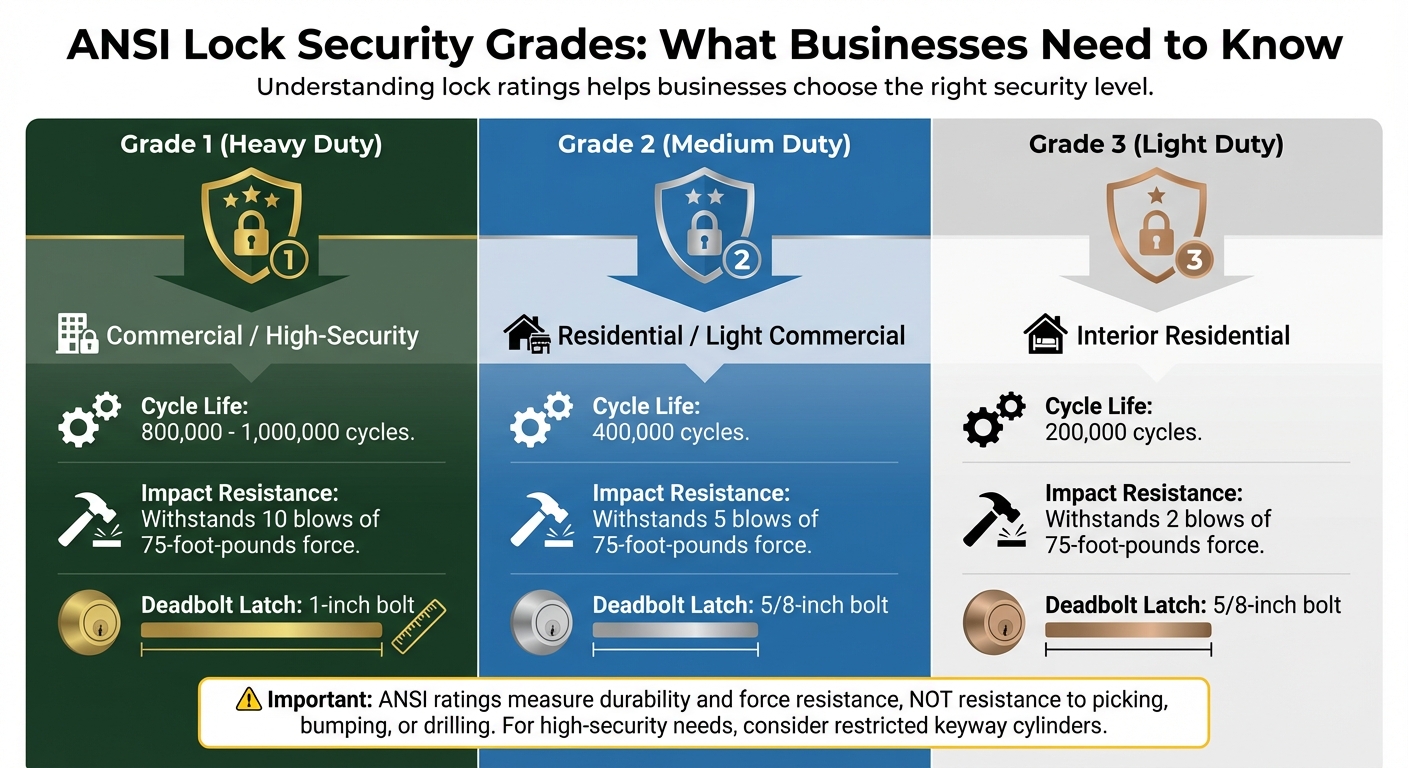
ANSI Lock Grade Comparison: Security Ratings for Commercial Doors
When locksmiths assess a property’s security, evaluating the locks is a key step. A lock’s ability to resist forced entry often separates a well-secured business from one that could be vulnerable. Locksmiths carefully check the quality, condition, and rating of each lock to ensure it meets the necessary standards.
Checking Lock Types and Grades
To determine a lock’s strength, locksmiths examine its ANSI/BHMA grade. These ratings range from Grade 1 (heavy-duty, commercial use) to Grade 3 (light-duty, residential use). If a lock’s grade isn’t clearly marked on the lock or packaging, locksmiths typically assume it’s a basic Grade 3.
The design of the lock often gives clues about its durability. For example, a Grade 1 deadbolt requires a 1-inch latch bolt, while lower grades may only feature 5/8-inch bolts. Beyond design, the difference in durability is striking. Grade 1 locks are built to handle 800,000 to 1,000,000 operational cycles, whereas Grade 3 locks are only tested for 200,000 cycles. Similarly, Grade 1 locks must endure 10 blows of 75-foot-pounds of force, compared to just 2 blows for Grade 3 locks.
| Feature | Grade 1 (Heavy Duty) | Grade 2 (Medium Duty) | Grade 3 (Light Duty) |
|---|---|---|---|
| Primary Use | Commercial / High-Security | Residential / Light Commercial | Interior Residential |
| Cycle Life | 800,000 – 1,000,000 | 400,000 | 200,000 |
| Impact Blows | 10 blows | 5 blows | 2 blows |
| Deadbolt Latch | 1-inch bolt | 5/8-inch bolt | 5/8-inch bolt |
Locksmiths also physically test the lock’s operation. For instance, the latch should close smoothly with no more than 4.5 pounds of force. If more force is needed, it could indicate wear or poor construction, which raises concerns about the lock’s reliability.
"ANSI ratings represent the durability and strength of a lock. These lock ratings do not represent a lock’s resistance to picking or other types of bypassing such as lock bumping or drilling." – Art of Lock Picking
It’s important to note that ANSI ratings focus on a lock’s ability to resist force, not methods like picking or drilling. For situations requiring extra security, locksmiths may suggest high-security cylinders with restricted keyways.
Once the lock’s grade and operation are verified, locksmiths look for physical evidence of tampering or wear.
Finding Signs of Tampering or Wear
Signs of tampering can reveal whether a lock has been compromised. For instance, deep scratches around the keyhole often indicate forced entry attempts, while fine scratches inside the keyway suggest picking. A loose lock cylinder or a bent keyhole may also point to tampering. Additionally, shiny metal shavings near the lock are a telltale sign of drilling attempts.
"A tampered lock is not always obvious at first glance, yet it’s a major red flag that your property may be at risk." – Brothers Locksmith
Mechanical issues inside the lock can also signal trouble. If a key is hard to insert or turn, this could mean the lock’s pins have been misaligned due to picking or force. For commercial locks with clutched levers, locksmiths check that the handle moves freely when locked. If it feels rigid, it might be vulnerable to being broken off with brute force. These inspections ensure the lock isn’t just secure on paper but can hold up under real-world challenges.
Key Management and Access Control Review
Securing a business goes beyond just installing strong locks. Effective key management and electronic access controls are essential to maintaining a solid security framework. Even the best lock can be compromised if keys aren’t properly tracked or if access systems are neglected. It’s worth noting that mechanical keys are still the primary security measure for 90–95% of business and institutional doors. This makes reviewing these systems an essential part of any security assessment.
Checking Key Control Practices
When locksmiths assess a business’s security, they start by examining its key control policies. This includes reviewing who has the authority to request keys, how returned keys are tracked, and where spare keys are stored [33, 34]. A common issue is poor documentation. Many businesses rely on outdated or incomplete records, like Key Bitting Arrays or keying schedules. This can lead to "key interchange", where a key unintentionally opens a lock it shouldn’t.
One alarming practice is the misuse of master keys. Some businesses issue master keys as a quick fix for missing employee keys, which can jeopardize the entire security structure.
"If you ‘solve’ missing user keys by copying the master key, you didn’t fix the problem – you escalated it." – Texas Master Locksmiths
Locksmiths also examine the physical keys themselves. They check for patented or restricted keyways, which legally block unauthorized duplication at hardware stores [33, 37]. Restricted keyways are a key defense against unauthorized duplication and accidental cross-keying [33, 36]. Additionally, locksmiths use diagnostic keys to decode master key systems without dismantling the locks, helping identify any unauthorized cross-keying [34, 35].
Proper master key systems require a logical and deliberate structure. Random assignments can lead to unauthorized access. For instance, with standard Kwikset (KW1) locks, there are only around 6,000 unique key combinations, meaning there’s a 1 in 6,000 chance that an outside key could unlock a specific door.
Once the physical key management is reviewed, locksmiths shift their focus to electronic access systems.
Examining Access Control Systems
Businesses using electronic access control systems need these systems to function seamlessly. Locksmiths check programming, battery health, access logs, and authentication methods like microchips, PINs, or biometrics. Even in facilities with electronic systems, 5–10% of doors still have mechanical overrides, which require the same level of careful key management as traditional locks.
Locksmiths also evaluate staff access levels and visitor management protocols to ensure permissions are up to date with the business’s current needs. Hardware inconsistencies, such as mixing different brands or cylinder formats, can disrupt the master key hierarchy and limit the system’s scalability. Modern digital cylinders offer features like access scheduling, audit trails, and remote updates, providing added flexibility.
"A utility-patented key system design is the foundation of an effective key control management program. Without a patented key system design in place, a customer cannot achieve true key control." – Dale L. Bowman, Director of Business Development, Medeco Security Locks
An important part of the review is ensuring that master key levels are correctly assigned and securely managed [1, 36]. Locksmiths recommend restricting master key access to high-level personnel, such as business owners or facility managers, to minimize potential risks from lost keys. They also advise conducting annual audits to reconcile issued keys with active employee roles [36, 37].
Security Weaknesses and Upgrade Recommendations
Locksmiths conduct thorough inspections and hardware evaluations to identify vulnerabilities and suggest practical, cost-effective upgrades to enhance security.
Listing Security Weaknesses
To prioritize repairs, locksmiths rank security gaps by severity. Common physical issues include using residential-grade locks on commercial doors, mortise locks vulnerable to twisting, exposed hinges on out-swing doors, and wide gaps between door frames and doors that make prying easier. Operational issues, like poor key control, active credentials for former employees, and propped-open fire or service doors, also pose significant risks.
"The gap between the frame and the door is one of the weakest points that can be attacked." – Acme Locksmith
Locksmiths typically organize their recommendations into three timelines: immediate fixes (addressed within 30 days) for urgent safety concerns, high-priority upgrades (completed within 90 days) for critical vulnerabilities, and longer-term improvements planned for the next budget cycle. This structured approach ensures businesses can address security concerns efficiently without disrupting daily operations. Considering the cost of a commercial break-in – ranging from $8,000 to $30,000 when factoring in property damage, theft, and downtime – investing in preventive upgrades is a smart move.
Once vulnerabilities are identified, locksmiths propose specific upgrades to address each risk.
Suggesting Security Upgrades
To mitigate risks, locksmiths recommend tailored upgrades. For example, adding torque collars to mortise locks in glass storefronts prevents cylinder extraction. Upgrading all exterior doors to ANSI Grade 1 locks ensures maximum strength and durability, while Grade 2 locks are better suited for interior spaces. Reinforcing wood door frames with 3-inch screws in strike plates helps anchor them securely into wall studs, making forced entry more difficult.
| Upgrade Type | Security Benefit | Common Hardware/System |
|---|---|---|
| High-Security Cylinders | Protects against picking, bumping, and unauthorized key duplication | Medeco, Mul-T-Lock, Marks |
| Physical Reinforcement | Prevents prying, kicking, or wrenching attacks | Latch guards, torque collars, door wraps |
| Electronic Access Control | Tracks access and allows instant deactivation of lost keys | Smart locks, keypads, biometric readers |
| Door Hardware Maintenance | Ensures doors close and latch properly every time | Commercial door closers, strike plate adjustments |
Implementing these upgrades not only enhances physical security but can also lower commercial insurance premiums by 5% to 20%, offering financial advantages beyond safety. Since many breaches involve insiders, integrating electronic access controls with audit trails is a critical step. Locksmiths also suggest testing surveillance cameras with the "newspaper test" – if a newspaper headline isn’t legible in the footage, the system needs improvement.
Conclusion
Getting a professional security assessment from a locksmith shifts your business from simply reacting to threats to actively preventing them. These assessments uncover weak points that your team might miss, like outdated locks or improperly installed hardware that could leave your property exposed.
The stakes are high – commercial break-ins can cost anywhere from $8,000 to $30,000, yet making the right upgrades could reduce your insurance premiums by 5% to 20%. Plus, these evaluations ensure your business complies with regulations like HIPAA, OSHA, and FERPA, demonstrating a commitment to due diligence. They also help you stay ahead by adapting your security measures to new and emerging risks.
"Security is never a one-time job but a continuous commitment." – Midtown Locksmith Services
Regular assessments keep your business prepared for evolving threats. By combining walkthroughs, hardware checks, and key system reviews, you get a clear, actionable report that prioritizes vulnerabilities and lays out a strategy to protect your assets, employees, and reputation.
If you’re in Pittsburgh, PA, and need a thorough commercial security assessment, Sherlock’s Locksmith is available 24/7. Their certified technicians are ready to evaluate and enhance your security systems to give you peace of mind.
FAQs
How often should my business get a locksmith security assessment?
Your business should plan for a locksmith security assessment at least once a year. It’s also smart to schedule one after major events, such as employee turnover or a security breach. These regular checkups help keep your property secure and ensure your systems stay updated.
What should I fix first if my budget is limited?
If you’re working with a tight budget, prioritize fixing the most critical vulnerabilities that offer the best return for improving security. For instance, replacing outdated or weak locks with high-security alternatives can make a big difference, as these are often the easiest targets for intruders. Consider getting a professional security assessment to pinpoint the most urgent risks. This way, you can ensure every dollar is spent wisely to strengthen your overall protection.
Do I need electronic access control or are upgraded locks enough?
When deciding between electronic access control systems and upgraded locks, it all comes down to your specific security needs and the level of protection you’re aiming for.
High-security mechanical locks can boost security and, in many cases, get the job done effectively. But if you’re looking for extra features, electronic access control systems bring a lot to the table. They offer perks like remote management, audit trails, and the ability to limit access to certain individuals.
For the best results, it’s worth consulting a professional locksmith. They can evaluate your security risks and guide you toward the most suitable solution for your business.