



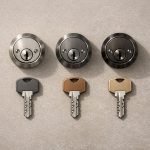
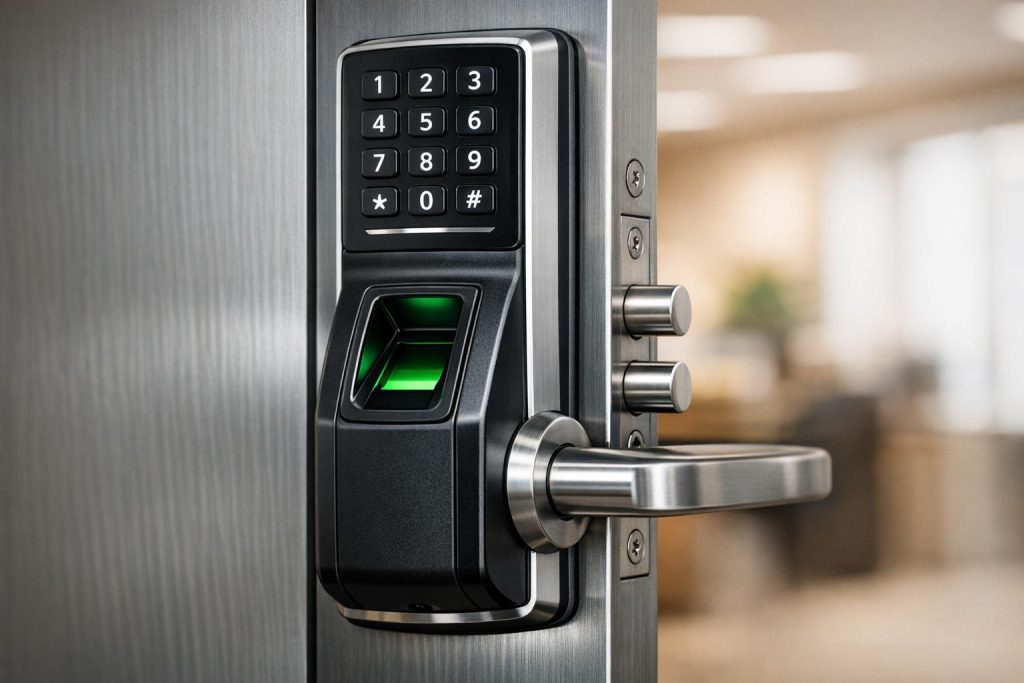
High-security locks are a critical investment for businesses looking to safeguard assets, sensitive information, and personnel. Unlike standard locks, these systems are designed to resist picking, drilling, and key duplication. They also offer patented key control, ensuring only authorized individuals can duplicate keys, reducing security risks. With options ranging from mechanical locks to electronic and biometric systems, businesses can tailor their security to specific needs. Here’s what you need to know:
- High-Security Features: Hardened steel components, resistance to tampering, and patented keyways for controlled duplication.
- Why Businesses Need Them: Prevents unauthorized access, reduces risks from lost or duplicated keys, and meets insurance requirements.
- Lock Standards: ANSI/BHMA grades (1-3) focus on durability, while UL 437 certification ensures resistance to tampering.
- Types of Locks: Mechanical (durable, key-based), electronic (keypads, RFID, audit trails), and biometric (fingerprint, facial recognition).
- Installation & Maintenance: Professional installation ensures proper alignment and security. Regular maintenance prolongs lock performance.
For exterior doors, Grade 1 locks with UL 437-certified cylinders provide maximum security. Interior spaces can benefit from Grade 2 locks or electronic systems. Biometric locks are ideal for highly sensitive areas. Prioritize professional installation and key management to create a reliable security system.
Locksmithing 101 | Lock Hardware Grades 1,2, and 3
Security Standards for High-Security Locks
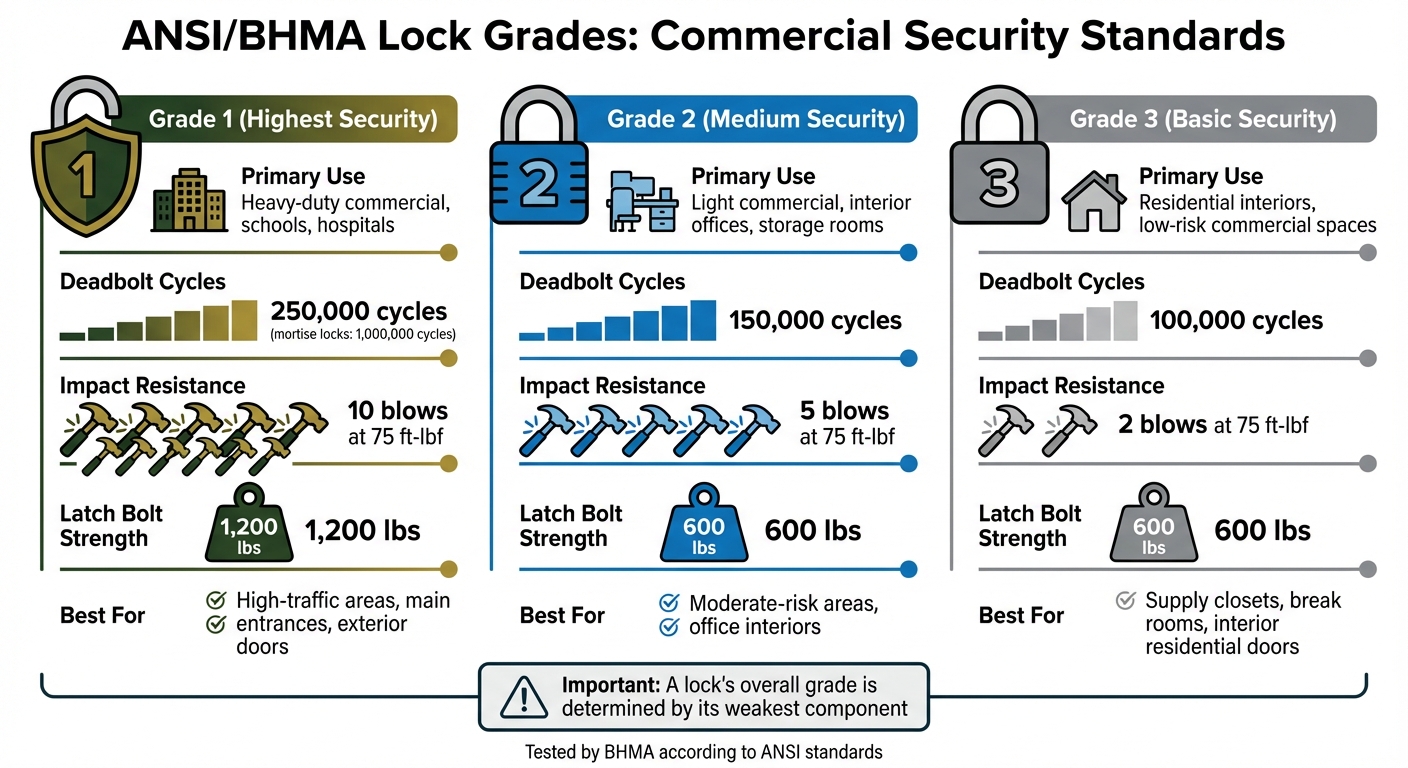
ANSI/BHMA Lock Grades Comparison Chart for Commercial Security
Security standards play a critical role in verifying the reliability of high-security locks, helping to separate genuine performance from marketing hype. Two key certifications dominate this field: ANSI/BHMA grading, which evaluates overall durability, and UL 437, which focuses on a lock cylinder’s resistance to tampering and forced entry.
ANSI/BHMA Lock Grades and Their Applications
The American National Standards Institute (ANSI) sets the testing guidelines, while the Builders Hardware Manufacturers Association (BHMA) independently tests and certifies locks based on these standards. Locks are assigned a grade – 1, 2, or 3 – depending on their performance across six categories: operational force, durability, load strength, impact resistance, material quality, and finish.
- Grade 1: Designed for heavy-duty commercial use, these locks are the most secure. They must endure 250,000 cycles for deadbolts and up to 1,000,000 cycles for mortise locks. Grade 1 hardware can withstand 10 blows at 75 foot-pounds of force and resist up to 1,200 pounds of pressure on the latch bolt. These are ideal for high-traffic areas like schools or hospitals.
- Grade 2: Suitable for light commercial or heavy residential use, such as office interiors or storage rooms. These locks are tested to handle 150,000 cycles, 5 blows at 75 foot-pounds, and 600 pounds of force on the latch bolt. They work well in moderate-risk areas.
- Grade 3: These locks are best for residential interiors or low-risk commercial spaces like supply closets. They are tested for 100,000 cycles, 2 blows at 75 foot-pounds, and 600 pounds of latch bolt force.
It’s important to note that a lock’s overall grade is determined by its weakest component. For instance, pairing a Grade 1 deadbolt with a Grade 3 strike plate results in a Grade 3 installation.
| Grade | Primary Use | Deadbolt Cycles | Impact Resistance | Latch Bolt Strength |
|---|---|---|---|---|
| Grade 1 | Heavy-duty commercial, schools, hospitals | 250,000 cycles | 10 blows (75 ft-lbf) | 1,200 lbs |
| Grade 2 | Light commercial, interior offices | 150,000 cycles | 5 blows (75 ft-lbf) | 600 lbs |
| Grade 3 | Residential, interior closets | 100,000 cycles | 2 blows (75 ft-lbf) | 600 lbs |
While ANSI/BHMA grades focus on overall durability, UL 437 certification zeroes in on the lock cylinder’s defense against tampering and forced entry.
UL 437 Standards for Lock Cylinders
Unlike ANSI/BHMA grades, which assess the durability of the entire lock, UL 437 certification is all about the lock cylinder’s ability to resist sophisticated attacks. Underwriters Laboratories test these cylinders against both covert methods (like picking and impressioning) and destructive techniques (such as drilling, sawing, and prying).
To pass UL 437 testing, a cylinder must:
- Resist picking and impressioning for at least 10 minutes.
- Withstand destructive attacks for at least 5 minutes using high-speed drills (up to 1,900 RPM) and professional manipulation tools.
- Offer a minimum of 1,000 unique key combinations and function reliably through 10,000 operational cycles.
High-security cylinders, such as the Medeco M4, can offer as many as 9,000,000 possible key combinations – far exceeding the roughly 100,000 combinations typical of standard residential locks. These advanced cylinders often feature hardened steel pins, sidebars, and rotating pin mechanisms, making them far more resistant to tampering.
Choosing the Right Lock Standard
Selecting the right lock standard depends on the specific security requirements of your space. For exterior commercial doors, main entrances, and high-traffic areas, Grade 1 hardware combined with UL 437-certified cylinders provides robust protection against both brute force and professional manipulation. For moderately secure spaces, like interior offices or storage rooms, Grade 2 locks are usually sufficient. Reserve Grade 3 locks for low-risk locations, such as break rooms or supply closets.
When purchasing locks, look for the BHMA certification mark to confirm independent testing. Many business insurance policies require Grade 1 or Grade 2 hardware for exterior doors, and upgrading to Grade 1 may even lower your premiums. For highly sensitive areas, such as server rooms or pharmacy storage, UL 437-rated cylinders are strongly recommended to guard against advanced attacks.
These standards provide a solid foundation for evaluating the different lock types discussed in the next section.
Types of High-Security Locks for Businesses
Once you’re familiar with the standards for high-security locks, the next step is finding the right type for your business. The three main categories – mechanical, electronic, and biometric – each bring distinct benefits depending on your security needs, budget, and how your business operates.
Mechanical High-Security Locks
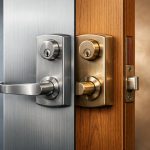
Mechanical locks rely on physical keys and sturdy internal mechanisms. They’re known for their durability and don’t require a power source to function. One standout example is the mortise lock, which is often considered the strongest option in this category. According to Trudoor, "A mortise lock is the strongest, most adaptable lock and is designed to handle high traffic, high abuse applications". These locks are ideal for exterior doors and high-traffic areas, capable of withstanding up to 800,000 cycles.
For lighter-duty applications, cylindrical lever locks are a good choice. They’re commonly used for interior office doors or conference rooms, meet ADA compliance, and typically have a Grade 2 rating – suitable for moderate security needs. For exterior doors, Grade 1 deadbolts provide resistance against forced entry, tested to endure 10 strikes and up to 360 pounds of force.
Key management is a critical aspect of mechanical locks. Features like restricted keyways and Interchangeable Core (IC) cylinders make rekeying easier. IC cylinders allow you to quickly replace the lock core using a control key, avoiding the need to disassemble the entire lock. However, for businesses seeking more flexibility, electronic systems are becoming an increasingly popular option.
Electronic and Smart Locks
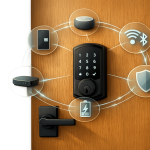
Electronic locks replace traditional keys with keypads, RFID cards, or Bluetooth-enabled smartphones. One of their standout features is the ability to maintain audit trails – digital logs that track who accessed specific areas. This makes them especially useful for securing sensitive spaces like server rooms or cash offices.
These systems also simplify access management. If an employee loses their credentials or leaves the company, their access can be revoked instantly through software, no on-site visit required – a major advantage for businesses with multiple locations. Many electronic locks are networked, allowing centralized management from a digital hub.
Common components include electric strikes, tested to handle up to 500,000 cycles, and electromagnetic locks (maglocks), which can withstand forces of up to 1,200 pounds. Since these locks require power, you’ll need to decide between "fail-safe" modes (unlock during power loss) and "fail-secure" modes (remain locked). Fire codes usually require fail-safe locks on emergency exit doors to ensure safe evacuation during power outages.
Electronic locks typically cost between $150 and $300 and can save money in the long run by eliminating traditional rekeying expenses, which usually range from $20 to $50 per lock. For even tighter security, biometric systems are an option.
Biometric Locks
Biometric locks authenticate users by scanning physical traits like fingerprints, facial features, or iris patterns. These systems offer a high level of personalized security, eliminating the risks associated with lost or stolen keys. When paired with Grade 1 hardware, biometric locks deliver exceptional durability and security. They also provide identity-linked audit trails, tying each access event to a specific individual.
This type of lock is ideal for highly sensitive areas like pharmacies, research labs, or data centers. Like electronic locks, biometric systems require a power source – either batteries or a hardwired connection – and generally fall within the $150 to $300 price range. While they offer advanced security, considerations like privacy and rare false rejections should be taken into account, though modern technology has significantly minimized such issues.
| Feature | Mechanical High-Security | Electronic Locks | Biometric Locks |
|---|---|---|---|
| Credential | Brass Key | PIN, RFID Card, Fob | Fingerprint, Iris, Face |
| Power Source | None (Manual) | Battery or Hardwired | Battery or Hardwired |
| Audit Trail | None | Yes (Digital Logs) | Yes (Identity-Linked) |
| Management | Physical Rekeying | Software/Remote Updates | Software/Remote Updates |
| Primary Strength | Durability & Reliability | Convenience & Scalability | Highest Personal Security |
| Primary Risk | Lost/Stolen Keys | Hacking/Power Failure | Privacy/False Rejection |
Selecting the right lock depends on your specific needs. For main entrances or exterior doors, Grade 1 mortise locks or deadbolts offer unmatched durability. Interior offices can benefit from cylindrical lever locks, which are ADA-compliant and easy to use. For areas like server rooms or stockrooms, electronic keypads or biometric systems with audit trails are particularly effective. Businesses with frequent staff changes might find IC cylinder locks or networked electronic systems helpful for reducing rekeying costs and hassle. Balancing convenience, cost, and security is key to making the right choice.
sbb-itb-643e28e
Installing and Maintaining High-Security Locks
Professional Installation for Best Results
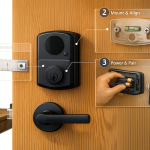
When it comes to high-security locks, professional installation is key to ensuring they perform as intended. Surprisingly, about 34% of break-ins happen through the front door, often because of poor installation or misaligned hardware. Professional locksmiths not only install locks but also match the lock grade to your specific security needs. For example, Grade 1 locks are often the go-to choice for high-traffic commercial exterior doors. They also focus on precise alignment and correct backset dimensions, which are especially important for commercial applications.
But it’s not just about the lock itself. Experts strengthen the entire locking system by adding latch guards, torque collars, and longer screws to ensure the door and frame are securely connected.
As Conner Mulrooney puts it, “A lock isn’t just a piece of metal; it’s the first real barrier against unauthorized entry. If it’s not installed correctly, it creates gaps that intruders can take advantage of”.
In Pittsburgh, Sherlock’s Locksmith offers professional installation services to ensure your high-security locks are properly aligned and reinforced. Once the locks are installed, managing who has access to them becomes the next step in securing your property.
Key Management and Access Control Policies
Having the right locks is only part of the equation; managing keys effectively is just as critical. Unauthorized key duplication is one of the most common security breaches in businesses, and relying on “Do Not Duplicate” stamps is far from foolproof. A better solution is a patented key control system, which ensures only authorized individuals can request new keys. These systems operate under U.S. patent laws, with violations carrying hefty penalties of up to $10,000.
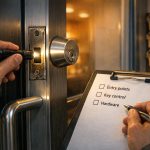
To tighten control, implement a formal key authorization process. Limit key requests to senior management and keep detailed records of every key issued. These records should include who holds the key, what areas it accesses, and how long it’s in use. For electronic systems, access can be revoked instantly via software, making them even more secure. Regular audits, ideally conducted by an external locksmith, can help ensure all keys are accounted for and highlight any potential vulnerabilities.
Routine Maintenance and Inspections
Keeping high-security locks in top shape requires regular maintenance. Every three months, clear out debris using pressurized air and apply a graphite-based lubricant. Avoid standard oils or WD-40, as they can attract dirt and cause the mechanism to jam. Check that your deadbolt moves smoothly into the strike plate – if it doesn’t, a sagging door could be putting excess pressure on the lock. For added security, inspect and replace hinge and strike plate screws annually with 3-inch screws.
If you’re using electronic or smart locks, stay on top of firmware updates to patch any vulnerabilities. Replace batteries proactively – typically once a year or as indicated by the system – to avoid unexpected lockouts. Also, keep one original factory key in a secure spot for making duplicates. Using worn keys or copies of copies can damage the internal pins of high-security cylinders over time.
Conclusion
High-security locks are designed to safeguard your assets, data, and intellectual property by standing up to advanced break-in techniques like lock picking, bumping, and drilling. Their precise engineering makes them a tough challenge for intruders, as breaching these systems takes more time and creates more noise – significantly increasing the chances of detection.
For example, a solid deadbolt can reduce the risk of a break-in by over 50%, and patented key systems can provide up to 1.97 billion unique combinations. But even the best lock is only as effective as its installation. Professional installation is key to ensuring proper alignment, reinforced frames, and well-matched components. These factors are essential for your lock to perform as intended when it matters most.
As one expert puts it:
"Security measures are deterrents to first discourage attacks, and secondly are ‘Time Machines’ which delay the entry and allow time for responders to intervene".
Beyond physical security, high-security locks can help you comply with insurance and regulatory requirements. Patented key control systems offer an added layer of protection by addressing unauthorized duplication concerns. In fact, under U.S. patent laws, penalties for duplicating patented keys without authorization can reach up to $10,000.
FAQs
What’s the difference between mechanical, electronic, and biometric high-security locks?
Mechanical high-security locks rely on physical keys and durable lock cylinders specifically designed to resist tampering techniques like picking, drilling, or creating unauthorized duplicates. Many of these locks meet rigorous security standards, such as UL 437 or ANSI A156.30, ensuring their reliability.
Electronic locks take a modern approach by replacing traditional keys with keypads, smart cards, or wireless credentials. These locks often include advanced features like encryption, audit trails to track access, and remote management capabilities. They’re a great choice for businesses that need more flexibility and detailed monitoring of who comes and goes.
Biometric locks step things up by using unique physical characteristics – like fingerprints or retinal scans – to grant access. This eliminates the hassle of carrying keys or remembering codes. They’re especially useful in settings where tight security and ease of use are top priorities.
What is UL 437 certification, and how does it improve lock security?
UL 437 certification guarantees that a lock has passed stringent security tests established by Underwriters Laboratories. Locks with this certification are designed to withstand multiple forced-entry techniques, such as picking, drilling, pulling, and impressioning. Additionally, they are constructed using precision-engineered, corrosion-resistant materials, ensuring durability and dependable performance over time.
For businesses, this certification provides confidence that their locks meet rigorous security standards, offering robust protection for assets and property.
Why should high-security locks be professionally installed?
Proper installation plays a key role in ensuring high-security locks function as intended. These locks need to be perfectly aligned with your doors, frames, and hardware to meet rigorous industry standards like UL 437 and ANSI/BHMA. These standards are specifically designed to enhance resistance against picking, drilling, and other tampering techniques.
Even the most advanced lock can fail to protect if installed incorrectly, leaving your property exposed to potential risks. Certified locksmiths bring the necessary skills and tools to install these locks correctly, ensuring they work seamlessly and provide reliable security for your business over the long term.