



When choosing locks, understanding UL (Underwriters Laboratories) and ANSI (American National Standards Institute) certifications is key. Both ensure quality but focus on different priorities:
- UL Standards: Test locks for resistance to attacks like picking, drilling, and fire exposure. Example: UL 437 evaluates locks against forced entry and tampering.
- ANSI Standards: Grade locks based on durability and performance under repeated use. Example: ANSI Grade 1 locks endure 250,000 cycles and heavy force.
Key Differences:
- UL ensures security and fire safety.
- ANSI focuses on longevity and strength for daily use.
For high-traffic areas, ANSI Grade 1 locks work well. For high-security or fire safety needs, UL-certified locks are better. Many businesses opt for locks with dual certification for both durability and advanced protection.
Quick Comparison:
| Feature | ANSI Standards | UL Standards |
|---|---|---|
| Focus | Durability and performance | Security and fire safety |
| Testing | Cycle counts, force tests | Resistance to attacks |
| Grading | Grade 1 (highest) to Grade 3 | Pass/Fail |
| Applications | High-traffic doors, offices | Banks, safes, fire-rated doors |
Choose based on your needs: ANSI for durability or UL for security. For the best protection, consider locks meeting both standards.
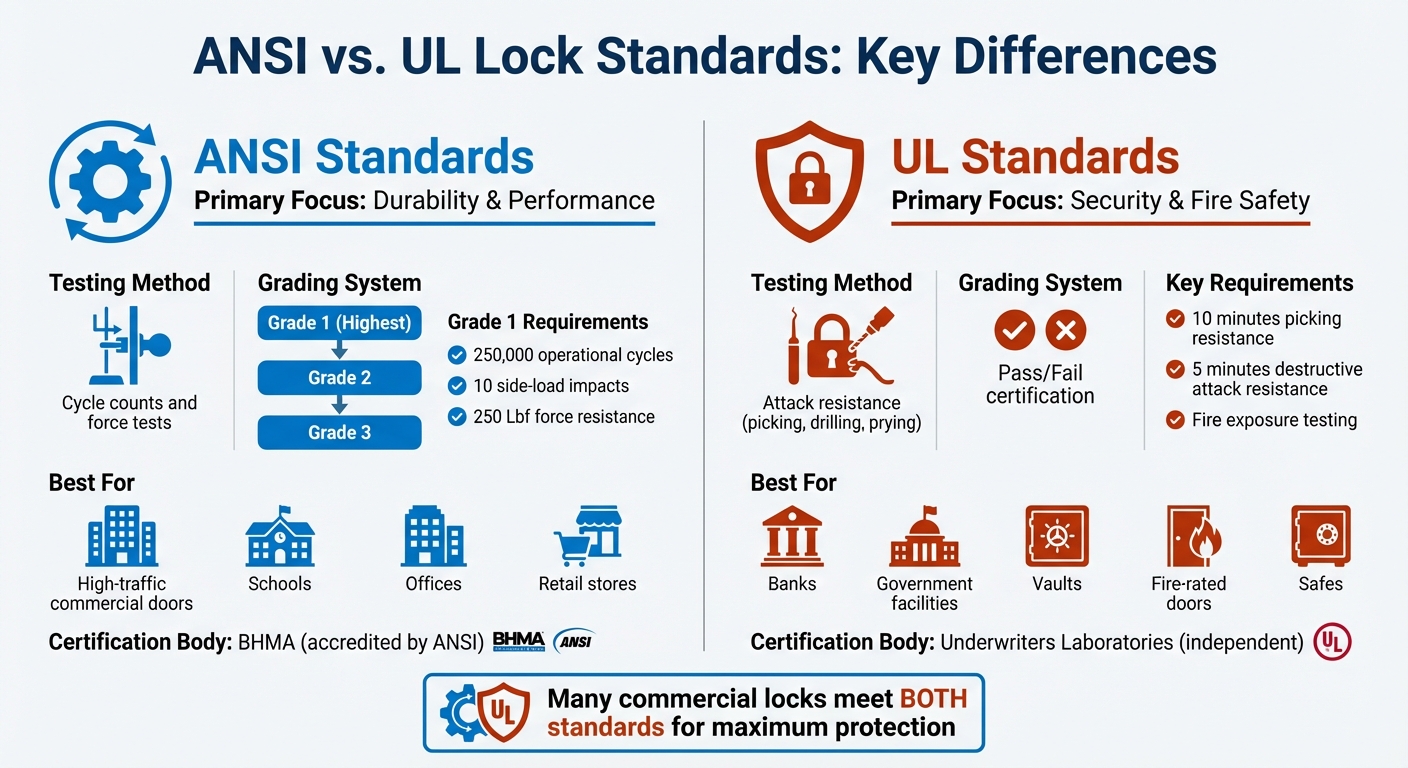
ANSI vs UL Lock Standards Comparison Chart
Lock Grades Explained – Understanding Lock Grades
You can also see examples of high-security lock installations we have completed for local clients.
sbb-itb-643e28e
What ANSI Standards Cover
ANSI develops standards for lock performance and durability, with BHMA overseeing the testing and certification process. In fact, over 80% of builders’ hardware manufacturers in the U.S. depend on BHMA standards to validate their products.
These tests assess key factors like operational cycles, strength, security, material quality, and finish. For example, a lock must handle thousands of operational cycles, resist significant force, and maintain its structural integrity under stress. Accredited laboratories conduct these tests to ensure that manufacturers meet the minimum reliability benchmarks. This emphasis on operational performance forms the backbone of the ANSI standards discussed below.
Main ANSI Standards for Locks
Several ANSI/BHMA standards govern different types of locks, each tailored to specific applications:
- A156.2: Covers bored locks and latches, commonly used for door knobs and levers.
- A156.13: Focuses on mortise locks, which are high-security systems often found in commercial buildings.
- A156.36: Applies to auxiliary deadbolts, frequently installed on exterior doors in both residential and commercial settings.
- A156.5: Evaluates cylinders and input devices for locks.
Mortise locks under A156.13 receive two ratings: an Operational Grade that measures durability and a Security Grade that tests resistance to forced entry. This dual grading system provides a well-rounded view of a lock’s performance, making it especially relevant for commercial settings where reliability is crucial.
How ANSI Grades Work
ANSI grades locks into three categories, with Grade 1 representing the highest standard. Here’s how the grades compare:
- Grade 1: Designed for heavy-duty use, these locks must endure 250,000 operational cycles, withstand 10 side-load impacts, and handle 250 pounds of force (Lbf) on the deadbolt plunger.
- Grade 2: Suitable for moderate use, these locks require 150,000 cycles, 5 impacts, and 150 Lbf.
- Grade 3: Intended for light-duty use, these locks must survive 100,000 cycles, 2 impacts, and 90 Lbf.
Grade 1 locks are ideal for high-traffic environments like schools, hospitals, and office buildings, where durability is critical. Grade 2 locks work well for residential entry doors and small offices, offering solid security. Grade 3 locks, on the other hand, are best for interior residential doors with lower security needs. Notably, insurance providers often require at least Grade 2 hardware for exterior doors and may even offer discounts for installing Grade 1 locks.
"A lock without certification may look strong, but ANSI/BHMA testing proves how it performs after years of real use." – GoTeamTrust
What UL Standards Cover
Unlike ANSI, which focuses on operational performance, UL standards are all about resisting criminal techniques and ensuring fire safety. These standards put locks through rigorous tests to assess their durability against unauthorized entry and fire hazards. Since 1921, Underwriters Laboratories has been evaluating burglar alarms and locks, building a strong reputation in security testing.
One key standard, UL 437, subjects locks to a battery of tests against methods like picking, impressioning, drilling, sawing, prying, pulling, punching, and forcing. For example, door locks must withstand picking for 10 minutes and destructive attacks for 5 minutes, while security container locks are tested to resist both picking and destructive attacks for 30 minutes.
Additionally, UL standards require locks to be crafted from corrosion-resistant materials like brass, bronze, or stainless steel. Precision engineering ensures reliable performance, with locks expected to function properly for 10,000 cycles at a maximum of 50 cycles per minute. These stringent requirements set the stage for the specific UL standards that guide these tests.
Main UL Standards for Locks
Here’s a closer look at the primary UL standards that manufacturers must meet:
- UL 437: This standard uses tools such as 3-pound hammers, 15-inch screwdrivers, and electric drills with speeds up to 1,900 RPM. Door locks and cylinders must offer at least 1,000 unique key variations (key differs), while security container key locks must provide a minimum of 1,000,000 key differs for heightened security.
- UL 10C: This standard focuses on fire safety, testing door assemblies under positive pressure to ensure they maintain structural integrity during a fire. It’s especially critical for commercial buildings, where fire-rated doors are required for safe egress.
Where UL Standards Are Used
UL ratings play a significant role across various industries. Government and law enforcement agencies rely on UL standards to secure their facilities and often recommend UL-rated locks to the public. In the banking and finance sector, UL standards are essential for high-security installations like burglar-resistant vault doors and safes.
Commercial real estate properties benefit from UL-certified hardware to meet fire code requirements, ensuring doors are equipped with fire-rated performance features. Retailers and logistics companies using collection safes or security containers also depend on UL 437 to safeguard against unauthorized access. For facilities at risk of advanced compromise techniques – such as drilling or picking – the time-based attack resistance tests under UL 437 provide an extra layer of assurance.
"Many government and law enforcement agencies use these ratings to select their own locks as well as recommend them to the public." – Lockwiki
ANSI vs. UL: Main Differences
When comparing ANSI and UL certifications, it’s clear that while both evaluate lock quality, they focus on different aspects of performance. ANSI standards emphasize durability and operational performance, ensuring locks can withstand repeated use over time. On the other hand, UL standards are geared toward security and safety, testing locks against physical attacks like picking or drilling, as well as fire hazards. ANSI testing typically involves cycle counts to measure endurance, while UL uses destructive testing to simulate real-world attack scenarios.
The grading systems highlight another distinction. ANSI uses a numerical grading scale: Grade 1 (the highest), Grade 2 (mid-level), and Grade 3 (basic). UL, however, certifies locks on a pass/fail basis for specific standards, such as UL 437 for keyed locks or UL 1034 for electronic locks. This makes UL’s approach more specialized, focusing on whether a lock meets stringent security benchmarks.
Here’s a quick breakdown of the main differences:
Comparison Table: ANSI vs. UL
| Feature | ANSI/BHMA Standards | UL Standards |
|---|---|---|
| Primary Focus | Durability, longevity, and operational performance | Security, attack resistance, and fire safety |
| Grading System | Grade 1 (Highest), Grade 2, Grade 3 | Pass/Fail for specific standards (e.g., UL 437) |
| Key Testing Areas | Cycle counts (up to 1,000,000), operational force, finish durability | Resistance to picking, drilling, prying, and fire exposure |
| Measurement Method | Number of cycles before failure | Time to resist attack (e.g., 10 minutes for picking) |
| Typical Application | High-traffic commercial doors, schools, offices | Banks, government facilities, vaults, fire-rated doors |
| Certification Body | Builders Hardware Manufacturers Association (BHMA) accredited by ANSI | Underwriters Laboratories (independent) |
Although these certifications are generally voluntary, they are often required by building codes or insurance providers. Many top-tier commercial locks achieve dual certification – meeting ANSI Grade 1 and UL 437 standards – indicating they can handle heavy use while offering strong protection against threats. This comparison helps identify which certification aligns more closely with your security needs.
Which Standard to Choose for Your Business
Selecting the right lock certifications is crucial for ensuring safety and meeting compliance requirements. Your decision between ANSI and UL certifications depends on factors like how often the locks will be used, local regulations, and the level of risk involved. For example, doors in high-traffic areas need locks designed to withstand constant use. Fire safety is another key consideration, especially when building codes or insurance policies demand specific certifications.
When ANSI Locks Are Enough
ANSI-certified locks are a solid choice for many businesses. Grade 1 locks are built for heavy use and are ideal for high-traffic spaces like retail stores, office buildings, and schools. They’re designed to handle frequent wear and tear while meeting industry and insurance standards. For areas with moderate traffic, such as smaller offices or residential-style commercial spaces, Grade 2 locks offer a dependable solution that still satisfies many insurance requirements for exterior doors. However, when heightened security or stricter compliance is necessary, UL-certified locks might be a better fit.
When UL Locks Are Needed
UL certification becomes critical when fire safety and high-security measures are priorities. These locks meet stringent fire code requirements and offer advanced protection against tampering methods like picking or drilling. Businesses handling high-value assets or operating under strict safety codes – such as banks, government facilities, or healthcare providers – often need UL 437-certified locks. This certification ensures a higher level of security for sensitive environments.
"Compliance issues usually appear after something goes wrong. Certified hardware helps avoid those problems before they start." – GoTeamTrust
Why Dual Certification Matters
In some cases, a single certification might not cover all your operational needs. That’s where dual certification comes into play. Locks that meet both ANSI Grade 1 and UL 437 standards deliver a combination of durability and advanced security. For exterior commercial doors or high-risk areas, this dual certification provides peace of mind by ensuring the lock can handle heavy daily use while resisting sophisticated attacks. It also helps reduce legal and insurance risks, offering a well-rounded solution for demanding environments.
Conclusion
Understanding the differences between ANSI and UL standards helps you make better decisions about security hardware. ANSI standards focus on durability and mechanical performance – evaluating how many cycles a lock can handle and how much physical force it can endure. On the other hand, UL standards emphasize resistance to specific attacks, such as picking, drilling, and fire. These certifications aren’t competing but rather address different aspects of security.
The right choice depends on your specific needs. For instance, high-traffic commercial spaces often benefit from ANSI Grade 1 locks, which can handle hundreds of thousands of cycles without failing. Meanwhile, facilities like banks or healthcare providers, which prioritize protection against tampering, typically require UL 437-certified locks. Many businesses opt for dual-certified locks to combine durability with advanced security, though selecting the best option usually calls for expert advice.
As mentioned earlier, these certifications address different risks, so professional input is key to aligning your security measures with your operational requirements. Factors like local building codes, insurance policies, and specific threat levels add layers of complexity. A certified locksmith can help identify vulnerabilities and recommend hardware that balances operational needs with compliance standards. For businesses in Pittsburgh, Sherlock’s Locksmith offers professional assessments and installs locks that meet ANSI and UL standards, ensuring both protection and regulatory compliance.
FAQs
Do I need UL, ANSI, or both for my doors?
The choice between UL 437 and ANSI/BHMA standards depends on your specific security and compliance needs. UL 437 focuses on evaluating a lock’s resistance to tampering and physical attacks, ensuring robust protection. On the other hand, ANSI/BHMA standards measure a lock’s durability and overall performance.
For high-security or commercial settings, many U.S. building codes suggest adhering to both standards. This approach helps ensure locks meet stringent requirements for both security and long-term reliability.
How can I verify a lock is truly UL or ANSI certified?
To confirm if a lock has UL or ANSI certification, look for official markings on the product or its packaging. These could include the UL mark or ANSI/BHMA grade labels, such as Grade 1, 2, or 3. You can also check the manufacturer’s documentation or reach out to the certifying organization directly. If you’re still uncertain, a professional locksmith can assist in verifying the certification.
Which UL and ANSI standards apply to my lock type?
The UL and ANSI standards for your lock vary based on its security level and certification requirements. UL primarily evaluates safety and resistance to physical attacks, while ANSI/BHMA grades (1, 2, 3) focus on durability and performance, with Grade 1 offering the highest level of reliability. To ensure compliance, review your lock’s specifications or labels for alignment with UL and/or ANSI/BHMA standards, depending on its intended use – whether it’s for residential, commercial, or high-security purposes.