







AI is transforming fire safety by making detection faster, smarter, and more reliable. While older systems rely on smoke or heat reaching a sensor, AI-powered alarms use video feeds, multi-sensor data, and machine learning to detect fires in seconds – often before smoke is visible. These systems reduce false alarms by analyzing flame behavior and environmental data in real time, achieving up to 92.6% accuracy in distinguishing real fires from harmless triggers like cooking smoke or steam.
Key benefits include:
- Faster detection: Fires identified in as little as 2 seconds.
- Fewer false alarms: Advanced algorithms cut unnecessary alerts.
- Predictive maintenance: AI monitors system health and flags issues early.
- Broader coverage: A single camera can oversee large areas.
AI also enables automatic responses, such as unlocking doors for evacuation or sending real-time alerts to emergency teams. These systems integrate with existing security setups, offering a cost-effective way to enhance fire safety without major hardware upgrades.
For businesses and homeowners, this means safer environments, fewer disruptions, and smarter fire prevention.
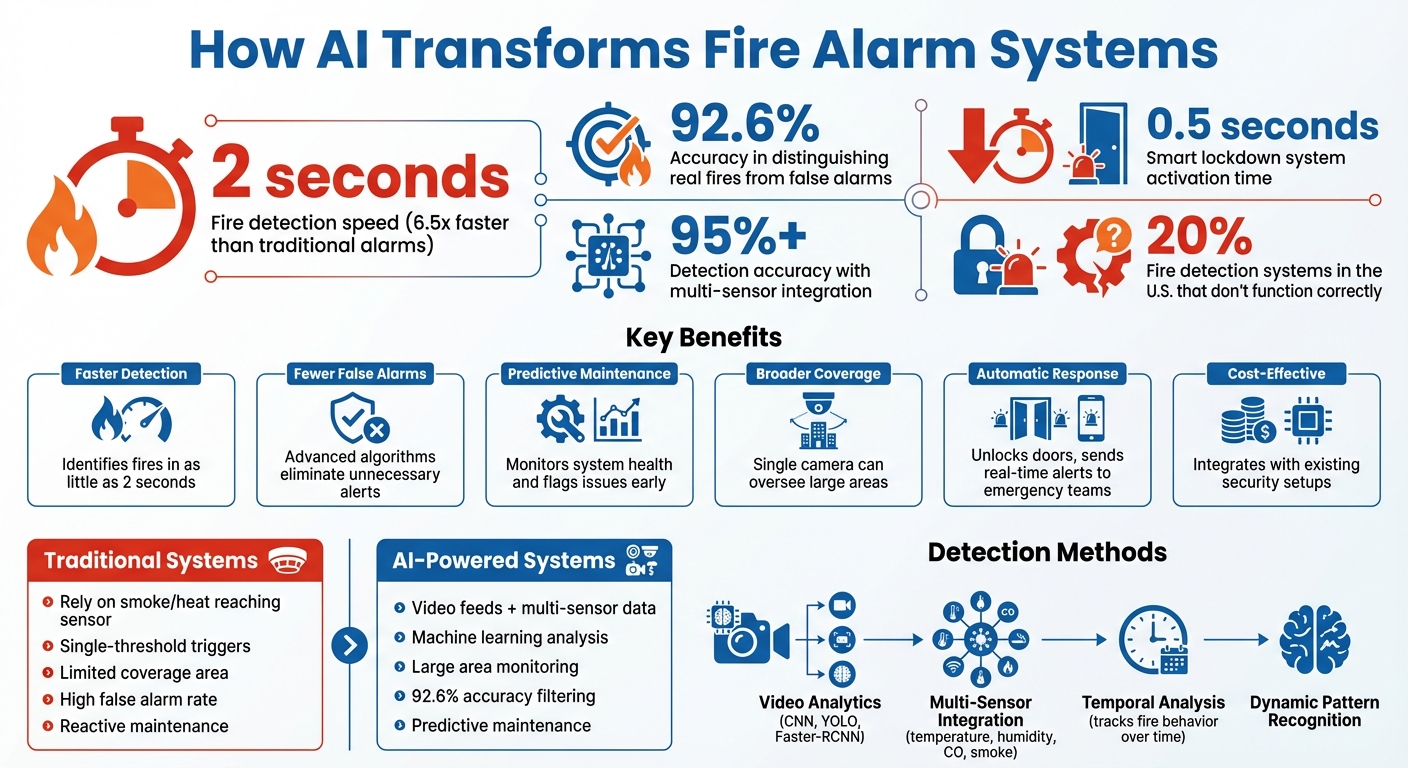
AI Fire Alarm Systems: Key Performance Statistics and Benefits
AI Hub: Fire & Smoke Detection
How AI Improves Fire Detection Speed and Accuracy
AI takes fire detection to the next level by combining speed and precision with advanced multi-sensor data integration and video analytics. Unlike traditional systems that rely on smoke or heat physically reaching a detector, AI processes real-time inputs from cameras and sensors, identifying patterns that single-sensor systems often miss. This multi-layered approach significantly boosts both accuracy and response speed.
AI systems analyze data from visual feeds, temperature, gas, and humidity sensors, adapting thresholds dynamically based on recent environmental conditions. Instead of fixed triggers that activate only under preset conditions, these systems recognize dynamic patterns that signal fire development. For instance, Deep Neural Networks can detect rapid temperature increases – like rises over 20°C per minute – by analyzing metrics such as Fire Feature Detection (FFD) and Fire Motion Detection (FMD).
AI With Multi-Sensor Technology
AI frameworks integrate inputs from a variety of sensors – temperature, humidity, carbon monoxide (CO), and smoke detectors – to detect fire patterns more effectively than any single sensor could. This approach overcomes limitations like cameras’ inability to see through walls and the false positives often caused by dust or steam in smoke detectors.
Research from the National Institute of Standards and Technology (NIST) highlights the effectiveness of combining multiple sensor types: "The best combination for early detection has been shown to be the complement of ionization, photoelectric, carbon monoxide, and temperature sensors". AI systems continuously adjust detection thresholds based on environmental changes, ensuring accurate responses. For instance, when a sudden temperature spike, an increase in CO levels, and visible smoke occur together, the system identifies a genuine fire threat rather than mistaking it for normal fluctuations.
By merging inputs from diverse sensors, this method achieves over 95% accuracy while cutting detection delays by 72% compared to traditional systems. Beyond sensor fusion, AI-powered video analytics further enhance detection by providing real-time visual verification.
Early Detection Using AI Video Analytics
AI video analytics revolutionize fire detection by identifying smoke or flames visually – often before traditional detectors can respond. Convolutional Neural Networks (CNN) and models like YOLO and Faster-RCNN analyze live video feeds to spot fire characteristics in their earliest stages.
A standout feature is temporal analysis, which tracks fire behavior across multiple video frames. This allows AI to differentiate between actual fires and static objects that might look like flames – such as a red car or a sunset. By monitoring dynamic growth patterns, these systems achieve 92.6% accuracy in distinguishing real threats from false positives.
Studies show that AI video detection can identify fires within 2 seconds of ignition, offering a 6.5 times improvement in warning efficiency compared to traditional alarms. Additionally, these systems can integrate with existing CCTV infrastructure, transmitting video streams to cloud-based servers using protocols like RTSP or RTMP. This eliminates the need for expensive hardware upgrades, making it a cost-effective solution for enhancing fire detection capabilities.
"Real fires are dynamic, growing and changing shape. Our system tracks these changes over time, achieving 92.6% accuracy in eliminating false detections." – Professor Sunil Kumar, NYU Tandon
Thanks to this visual intelligence, a single camera can monitor large areas that would typically require multiple conventional sensors, making fire detection not only faster but also more efficient.
How AI Reduces False Alarms
False alarms aren’t just annoying – they can be dangerous. When alarms repeatedly go off without reason, people often disable them, which can be deadly. In fact, about 11% of residential fire fatalities in homes with non-functioning smoke detectors are tied to this very issue. AI steps in to tackle this problem by analyzing environmental conditions in real time, sifting out harmless triggers from actual fire threats. In addition to speeding up detection, AI sharpens alarm accuracy by reducing false triggers.
What Causes False Alarms
Everyday household activities are a major culprit behind false alarms. Cooking smoke – especially from frying bacon – is one of the most common triggers. Steam from hot showers, dust stirred up during cleaning, and even tiny insects inside the sensor chamber can also set off alarms. As the National Institute of Standards and Technology (NIST) aptly puts it:
"New smoke alarms are better at detecting fires but still beep for bacon".
The problem lies in how traditional smoke detectors work. They rely on single-threshold triggers: once a specific level of smoke is detected, the alarm sounds, regardless of whether it’s a fire or just burnt toast.
How AI Filters False Positives
AI takes a smarter approach to reduce false alarms. Rather than relying on a single sensor or threshold, AI systems use multiple layers of verification before sounding the alarm. This ensemble approach combines input from several AI models, ensuring a consensus is reached to avoid mistaking harmless cues for real danger.
One of the key techniques AI employs is temporal analysis, which tracks changes in objects over time. Fires are dynamic – they grow, change shape, and spread. By monitoring these patterns, AI can tell the difference between a growing fire and a static object, achieving an impressive 92.6% accuracy in filtering out false alarms.
AI also integrates data from various sensors – photoelectric, ionization, carbon monoxide, and temperature sensors – to create detailed fire signatures. For example, if smoke triggers a photoelectric sensor but CO levels and temperature remain stable, the system identifies the event as harmless, such as cooking smoke, rather than a fire. Users can even adjust sensitivity settings to suit specific environments. For instance, kitchens prone to cooking smoke can have lower sensitivity, while areas with flammable materials can maintain higher sensitivity.
This advanced filtering not only minimizes false alarms but also strengthens overall fire safety measures, ensuring faster and more reliable responses when real threats arise.
sbb-itb-643e28e
AI for Predictive Maintenance in Fire Alarm Systems
Traditional fire alarm maintenance often depends on annual inspections or waiting for something to break before fixing it. This approach leaves systems vulnerable, and it’s estimated that around 20% of fire detection systems in the U.S. don’t function correctly – mainly because problems can develop between scheduled checks. AI-driven systems tackle this issue by continuously monitoring equipment and identifying potential problems before they become critical. This creates a system where performance is tracked in real time, and issues are detected immediately.
How AI Monitors Device Performance
AI systems analyze performance data nonstop, spotting unusual behavior as soon as it happens. For instance, if a sensor starts acting up or a wireless connection weakens, the AI sends an alert to managers and initiates self-checks for issues like low batteries or other malfunctions.
Andrew Erickson, an Application Engineer at DPS Telecom, highlights this transformation:
"AI changes this by predicting failures before they happen… If a sensor starts reporting odd readings or a communication path begins to fail intermittently, an AI system can flag it immediately".
Smart detectors take this a step further by notifying building managers directly about maintenance needs, like low batteries, removing the uncertainty of when replacements are required. Some systems also rely on centralized processing. This means the heavy data analysis happens remotely in a secure location, and on-site hardware is updated with simplified rules through software updates. The result? Advanced monitoring capabilities without the high cost of maintaining local servers.
Advantages of Predictive Maintenance
With predictive maintenance, servicing happens only when necessary. This approach minimizes system downtime, ensures compliance with fire safety standards like NFPA 72, and cuts costs by avoiding unnecessary service calls while addressing real problems before they worsen.
A study by the National Research Council Canada supports this:
"Self-maintenance notification in the smoke detectors would result in fewer false alarm triggers".
For commercial properties, these systems mean fewer evacuations, less disruption to daily operations, and improved safety for occupants. They also adapt to the unique conditions of each building, adjusting for factors like dust and humidity to avoid triggering false alarms.
Connecting AI Fire Alarms With Security and Locksmith Services
Pairing AI-powered fire alarms with security systems takes emergency response to a whole new level. These advanced fire alarms now work in tandem with access control systems and electronic locks, creating a coordinated approach that prioritizes safety while maintaining building security.
How Fire Alarms Integrate With Access Control
When a fire is detected, the AI system communicates with the access control system – usually by connecting the alarm panel to a backup power controller – to cut power to electronic locks. This action automatically unlocks all exits, allowing for smooth evacuation.
Some systems go beyond the basics by incorporating voice evacuation technology. Instead of blaring sirens, these systems deliver clear, spoken instructions to guide people toward the safest exits. AI video analytics add another layer of sophistication by pinpointing the exact fire location and identifying individuals who may be trapped. This real-time data equips emergency responders with critical information before they even step inside.
The speed of these integrated solutions is impressive. Smart lockdown systems can activate door locks, adjust camera settings, and send emergency alerts – all in under 0.5 seconds, thanks to IoT triggers. Many systems also connect to mass notification platforms, broadcasting emergency messages through SMS, email, and digital screens.
However, achieving this level of integration requires precise installation and expert knowledge.
Sherlock’s Locksmith: Ensuring Seamless Integration

When it comes to integrating these advanced systems, professional expertise is non-negotiable. Proper installation not only ensures compliance with fire safety codes but also guarantees that all components work flawlessly in emergencies.
Sherlock’s Locksmith, based in Pittsburgh, PA, specializes in blending security and fire safety systems. Their certified technicians excel at connecting access control panels to fire relays, ensuring systems meet all safety standards and operate efficiently when it matters most.
With expertise in access control systems, keyless entry, and biometric locks, Sherlock’s Locksmith is well-equipped to handle the complexities of AI fire alarm integration. They offer 24/7 mobile service across Pittsburgh, covering areas like Cranberry, Fox Chapel, Mount Lebanon, and Shadyside. Whether you’re upgrading your current setup or installing a new system, they ensure all components work seamlessly together during emergencies.
Conclusion: How AI Transforms Fire Safety
Artificial intelligence is changing the game in fire safety by addressing the limitations of traditional alarm systems. AI-powered detection can identify fires in as little as 2 seconds, drastically reducing response times compared to conventional alarms.
One of the biggest challenges in fire safety – false alarms – is being tackled head-on by AI. With an impressive 92.6% accuracy, AI minimizes false detections by analyzing flame behavior over time.
AI also ensures continuous monitoring of device performance, alerting operators to potential malfunctions before they pose a risk. These systems provide broader coverage and integrate seamlessly with existing setups. As Prabodh Panindre from NYU Tandon highlights:
"A single camera can monitor a much larger area than traditional detectors, and we can spot fires in the initial stages before they generate enough smoke to trigger conventional systems".
Beyond improved safety, these advancements simplify integration into current security frameworks. For property owners in Pittsburgh looking to adopt these AI-driven systems, Sherlock’s Locksmith offers solutions that combine fire alarm systems with modern access control technologies. Their certified technicians ensure all components work flawlessly during emergencies, meeting fire safety codes while maintaining security. With 24/7 mobile service across Pittsburgh, they handle everything from new installations to system upgrades, making the most of your existing infrastructure.
FAQs
How does AI help fire alarm systems reduce false alarms?
AI-powered fire alarm systems are changing the game when it comes to reducing false alarms. By leveraging machine learning algorithms, these systems analyze sensor data to differentiate between actual fire-related smoke or flames and harmless triggers like dust, steam, or even cooking fumes. This ability to pick up on subtle differences helps prevent those frustrating and unnecessary alerts.
Some systems take it a step further by incorporating video analysis. They use visual cues to identify real fires, adding another layer of precision. This smarter detection approach doesn’t just boost safety – it also cuts down on the disruptions caused by false alarms.
How does AI help with predictive maintenance in fire alarm systems?
AI improves fire alarm systems by assessing sensor performance and usage trends to anticipate potential component failures. This predictive approach helps schedule maintenance or replacements before problems occur.
By automating these maintenance tasks, AI minimizes downtime, avoids system failures, and ensures fire alarms operate smoothly, boosting both safety and dependability.
How does AI enhance fire alarm systems and integrate with security setups?
AI-powered fire alarm systems integrate effortlessly with current security setups by linking to devices such as security cameras and IoT-enabled sensors. With advanced video analytics and data from these tools, AI can identify potential fire hazards quickly and send alerts straight to the building’s security management platform, enabling a faster and more coordinated response.
Beyond speeding up detection, these systems also minimize false alarms by analyzing patterns and differentiating between real threats and harmless events. This smart integration provides more dependable monitoring, offering better protection for both properties and the people inside.