









Crime Prevention Through Environmental Design (CPTED) focuses on designing spaces to deter crime and improve safety. If you’re considering a CPTED program, accreditation is key – it ensures the program meets industry standards and provides recognized certifications like the CPTED Professional Designation (CPD) or Certified CPTED Specialist. These credentials can enhance your career and credibility in fields like security, urban planning, or law enforcement.
Here’s a quick look at some top online CPTED programs:
- NICP CPTED Courses: Offers Basic and Advanced courses with lifetime access. Prices start at $695 and include hands-on projects like field assessments.
- Atlas Safety and Security Design: An ICA-recognized program with a structured semester schedule, ideal for those pursuing International CPTED Association Certification (ICCP).
- ASIS International Essentials of CPTED Certificate: A budget-friendly option ($175 for members) with a self-paced format, offering 3.5 CPE credits but no fieldwork.
- International CPTED Association Certification Program (ICCP): The global standard for CPTED certification, offering direct pathways to professional-level credentials.
Key Considerations:
- Accreditation: Look for programs recognized by the International CPTED Association (ICA) or offering certifications like CPD or ICCP.
- Cost vs. Value: Compare tuition fees against benefits like lifetime access, CPE credits, and career opportunities.
- Hands-On Learning: Programs with practical exercises, like field assessments, provide better preparation.
- Career Goals: Choose a program that aligns with your professional needs, whether you’re a beginner or an experienced professional.
Selecting the right CPTED program can make a significant impact on your expertise and career trajectory. Below, we dive deeper into these programs and their features.
CPTED explained for Security Professionals | Crime Prevention Guidelines, Standards & Certification
What CPTED Accreditation Means
Understanding CPTED accreditation is essential for assessing the credibility of related programs. CPTED professional certification confirms actual expertise – not just attendance. The International CPTED Association (ICA) defines professional certification as "an independent, third-party confirmation of professional competence". This is a crucial distinction because a standard course certificate only shows that someone attended training – it doesn’t verify their skills or knowledge independently.
The ICA sets training standards through its Course Accreditation Program (CAP), which aligns with the core competencies required for individual practitioner certification. The CAP Review Committee evaluates programs by examining disclosed syllabi, conducting instructor interviews, reviewing surveys, and auditing materials. Programs can achieve Class A accreditation by covering all eight mandatory core competencies and including a field project (costing CA$1,000 for course developers). Alternatively, Class B accreditation is available for programs focusing on one to seven specific competencies, at CA$300 per competency. This thorough review process ensures the reliability that professionals in the field depend on.
"Certification also serves to lock out charlatans claiming to be ‘trained’ or ‘certified’ by merely attending a course or taking a test." – International CPTED Association (ICA)
Governments and development authorities increasingly require accredited CPTED programs for project approvals. These programs often provide a "fast-track" path to individual professional certification (ICCP), exempting graduates from extensive documentation requirements when completing a Class A accredited course. Both course accreditations and individual certifications must be renewed every three years to ensure that practitioners stay up-to-date with advancements in the field.
The ICCP, introduced in 2004 for CA$315, demands mastery of eight core competencies for Practitioner-level certification or eleven for Professional-level certification. Recertification, which costs CA$100 every three years, requires practitioners to submit three new proofs of continued competency. This ongoing process ensures that certified professionals maintain their expertise and adapt to evolving standards in the field.
Best Accredited Online CPTED Programs
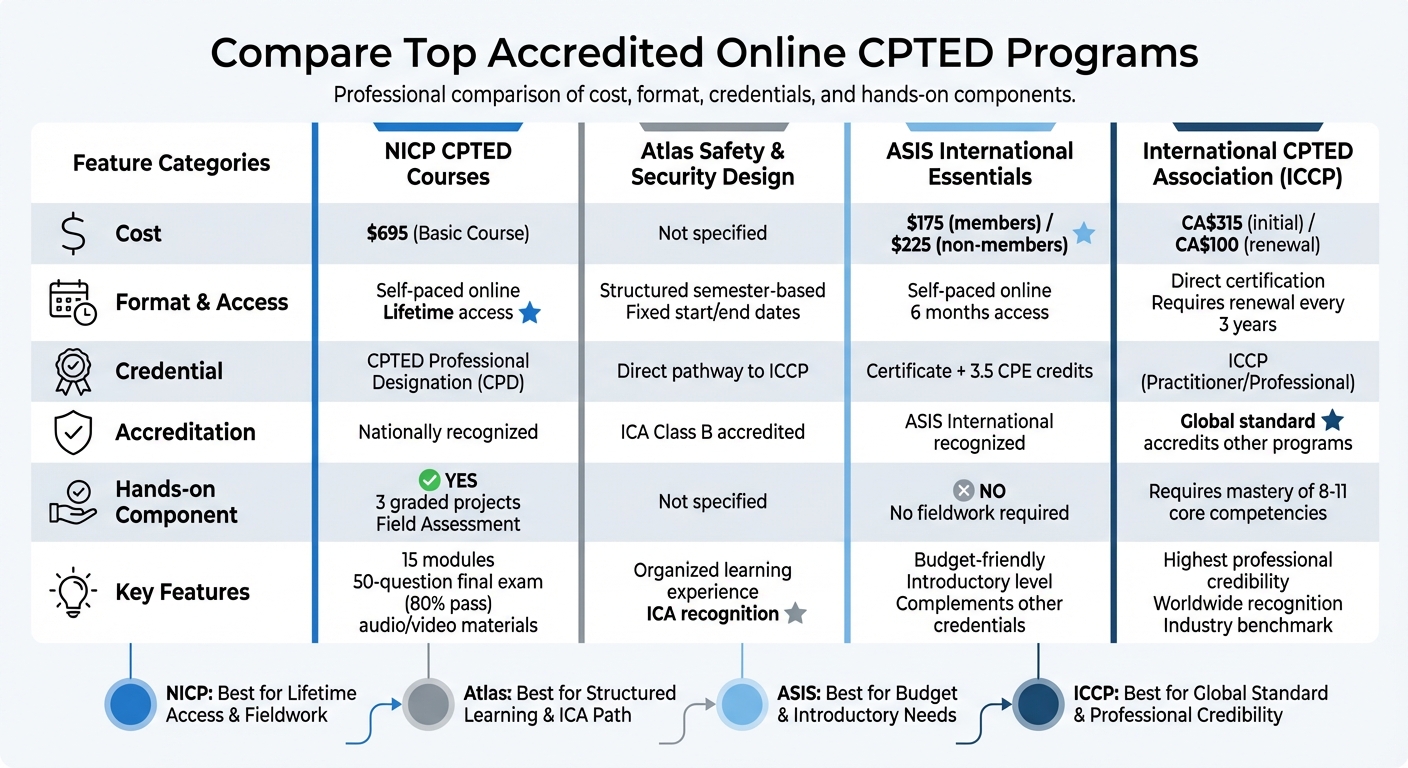
Comparison of Top 4 Accredited Online CPTED Programs
Here are four standout online CPTED programs that provide accredited credentials. Each program adheres to strict industry standards, ensuring high-quality training.
National Institute of Crime Prevention (NICP) CPTED Courses
The NICP offers both Basic and Advanced CPTED courses in a self-paced online format. Once enrolled, students gain lifetime access to all course materials. Completing the program earns participants the CPTED Professional Designation (CPD), a nationally recognized credential.
- Basic CPTED Course: Priced at $695, this course includes 15 modules covering topics like safety lighting, physical barriers, zoning, traffic calming, and site plan reviews.
- Assessments: Students must pass quizzes for each section and a 50-question final exam with a score of at least 80%. Additionally, three graded projects are required, including a CPTED Field Assessment and Presentation. This involves visiting an approved location, gathering demographics and crime data, and conducting interviews with property stakeholders.
The platform provides audio presentations, videos, and a detailed manual. Users have praised the platform for being easy to navigate, while instructors are noted for offering personalized feedback. Reviews highlight the course’s practical and relevant content, which is designed to apply globally rather than focusing solely on U.S. contexts.
Atlas Safety and Security Design CPTED Practitioners Certification

Recognized by the International CPTED Association (ICA), this Class B accredited program offers a structured, semester-based schedule. Unlike self-paced options, the defined start and end dates provide a more organized learning experience.
Graduates of this program can follow a direct pathway to the International CPTED Association Certification Program (ICCP), making it a popular choice for professionals seeking ICA certification.
ASIS International Essentials of CPTED Certificate

ASIS International provides an introductory CPTED certificate designed to complement other security credentials. This program is offered in a self-paced online format with a 6-month access period.
- Cost: $175 for members, $225 for non-members.
- Credits: Completion awards 3.5 Continuing Professional Education (CPE) credits.
- Focus: The course emphasizes core CPTED principles and skills but does not require hands-on fieldwork.
ASIS International emphasizes that "the proper design and effective use of the built environment can lead to a reduction in the incidence and fear of crime."
International CPTED Association Certification Program (ICCP)
The International CPTED Association Certification Program (ICCP) serves as the global standard for professional CPTED training. It also acts as the accrediting body for other programs through its Course Accreditation Program, ensuring high standards across the field.
Certification Pathways:
- Professionals can directly pursue certification through the ICCP.
- Alternatively, they can complete a Class A accredited course to qualify.
Beyond certification, the ICCP sets industry benchmarks by thoroughly reviewing syllabi, instructor qualifications, and course materials from other training providers. This program is recognized worldwide and represents the highest level of professional credibility in CPTED.
sbb-itb-643e28e
How to Select the Right Online CPTED Program
Checking Accreditation and Industry Recognition
Accreditation plays a key role in ensuring the credibility of your certification. Designations like the CPTED Professional Designation (CPD) or Certified CPTED Specialist are far more respected than standard certificates. It’s also worth checking if the program offers Continuing Professional Education (CPE) credits recognized by organizations like ASIS International. These credits are invaluable for maintaining other security-related certifications throughout your career.
Another important factor is whether the certification is lifetime or requires periodic renewal, which may involve extra fees. Organizations like NICP and ACPI provide lifetime certifications, saving you from recurring costs and administrative hassles. Taking the time to verify these details ensures your credentials reflect actual expertise rather than just course participation.
Of course, accreditation is just the starting point. A solid curriculum is just as crucial, as discussed in the next section.
Reviewing Course Structure and Content
The value of accreditation depends heavily on the quality of the curriculum it validates. Before committing to a program, take a close look at the course content. A strong curriculum should cover both the theoretical foundations of CPTED and its practical applications, tailored to real-world scenarios. For security professionals, it’s essential that the program also addresses legal topics like premises liability, zoning regulations, and ordinances.
Hands-on experience is often more valuable than traditional exams. Look for programs that include practical exercises such as blueprint analyses, site plan evaluations, or field assessments. Additionally, consider the program’s format. Live Online sessions provide opportunities for real-time interaction and networking, while On-Demand options are ideal for professionals juggling busy schedules.
Matching Programs to Career Goals
Once you’ve evaluated the certification and curriculum, think about how the program aligns with your career objectives. If you’re new to CPTED, introductory courses can provide a solid foundation without requiring extensive field experience. For seasoned security professionals, advanced programs offer a chance to deepen expertise and earn higher-level credentials.
The qualifications of the instructors can also make or break the training experience. Top-tier courses are often led by experts with significant real-world experience. For example, Dan Keller from the American Crime Prevention Institute brings decades of law enforcement knowledge to his teaching, enhancing the program’s credibility. Similarly, ICA-accredited courses require lead instructors to hold active ICCP certification and maintain membership with the International CPTED Association, ensuring they meet high professional standards.
Final Recommendations
When selecting a program based on the CPTED principles and accreditation standards discussed earlier, it’s essential to align your certification goals with your career aspirations. Programs like NICP or ACPI offer credentials that are widely respected and have enduring value. If you already hold other security certifications, focus on programs that provide Continuing Professional Education (CPE) credits recognized by ASIS International. This ensures your efforts contribute to maintaining your credentials while advancing your expertise.
Practical application is another critical factor. As mentioned earlier, programs that include hands-on components – such as graded field assessments, blueprint exercises, or site plan reviews – are more effective than those relying solely on multiple-choice exams. For example, NICP requires participants to conduct practical field assessments at actual sites, bridging the gap between classroom theory and real-world practice.
Tailor your choice to your area of expertise within the security field. Some programs cater to specific sectors, while others are designed for broader commercial applications. If your work spans international boundaries, the ICA’s ICCP certification is worth considering. It offers global recognition and has an initial application fee of about $230 USD.
Lastly, weigh the cost of the program against its long-term benefits. Look for features like lifetime access to materials, the opportunity to earn CPE credits, and whether the certification can open consulting opportunities. These factors can help ensure your investment pays off in the long run.
FAQs
Is a CPTED course certificate the same as professional CPTED certification?
A CPTED course certificate indicates that you’ve completed a particular training program and may serve as proof of knowledge or provide continuing education credits. However, professional CPTED certification is a more advanced credential that typically involves a formal process and recognition within the industry. For instance, certifications like the CPTED Practitioner Certification from the ICA are acknowledged as professional-level qualifications. It’s important to note that a course certificate alone does not equal professional certification unless it is explicitly stated.
How do I verify a CPTED program is ICA-accredited (Class A or Class B)?
To verify if a CPTED program has ICA accreditation, check its inclusion in the ICA Course Accreditation Program (CAP) or the ICA CPTED Certification Program (ICCP). These programs categorize accreditation into two levels: Class A and Class B. You can visit the ICA website to view the official listings and confirm that the program adheres to the established standards.
Do I need fieldwork to earn a respected CPTED credential?
Earning a recognized CPTED credential typically involves completing an online course or training program centered on strategies for environmental design. These programs are fully online and do not require any fieldwork.